
If you have ever had a suspicious mole, unusual rash, skin growth, or skin biopsy, you may have come across the term dermatopathologist. But what is dermatopathologist, and what exactly does this specialist do?
A dermatopathologist is a physician who has specialized training in both dermatology and pathology. Their main role is to diagnose diseases by examining samples of skin, hair, nails, and related tissues under a microscope. In many cases, a dermatologist removes a small piece of abnormal skin and sends it to a dermatopathologist for a detailed examination.
This work is especially important when a skin problem cannot be diagnosed confidently just by looking at it. A biopsy can reveal information that cannot be seen during a normal skin examination. This may help doctors distinguish between a harmless growth, an inflammatory skin disease, an infection, or skin cancer.
The American Academy of Dermatology explains that dermatopathologists combine knowledge of dermatology and pathology to examine tissue obtained through skin biopsies. Their written pathology report can help the treating dermatologist understand what condition is present and what treatment may be appropriate.
This guide explains what a dermatopathologist is, what they do, how they differ from dermatologists and general pathologists, what happens to a skin biopsy, what conditions they diagnose, how they are trained in the United States, and why their work matters for patients.
What Is Dermatopathologist?
The phrase “what is dermatopathologist” is essentially asking about a medical specialist who focuses on diagnosing skin disease by studying tissue and cells.
A dermatopathologist is a doctor with advanced knowledge of both dermatology and pathology. Dermatology focuses on diseases of the skin, hair, and nails, while pathology focuses on identifying disease by examining tissues, cells, and other biological samples.
A dermatopathologist brings these two areas together.
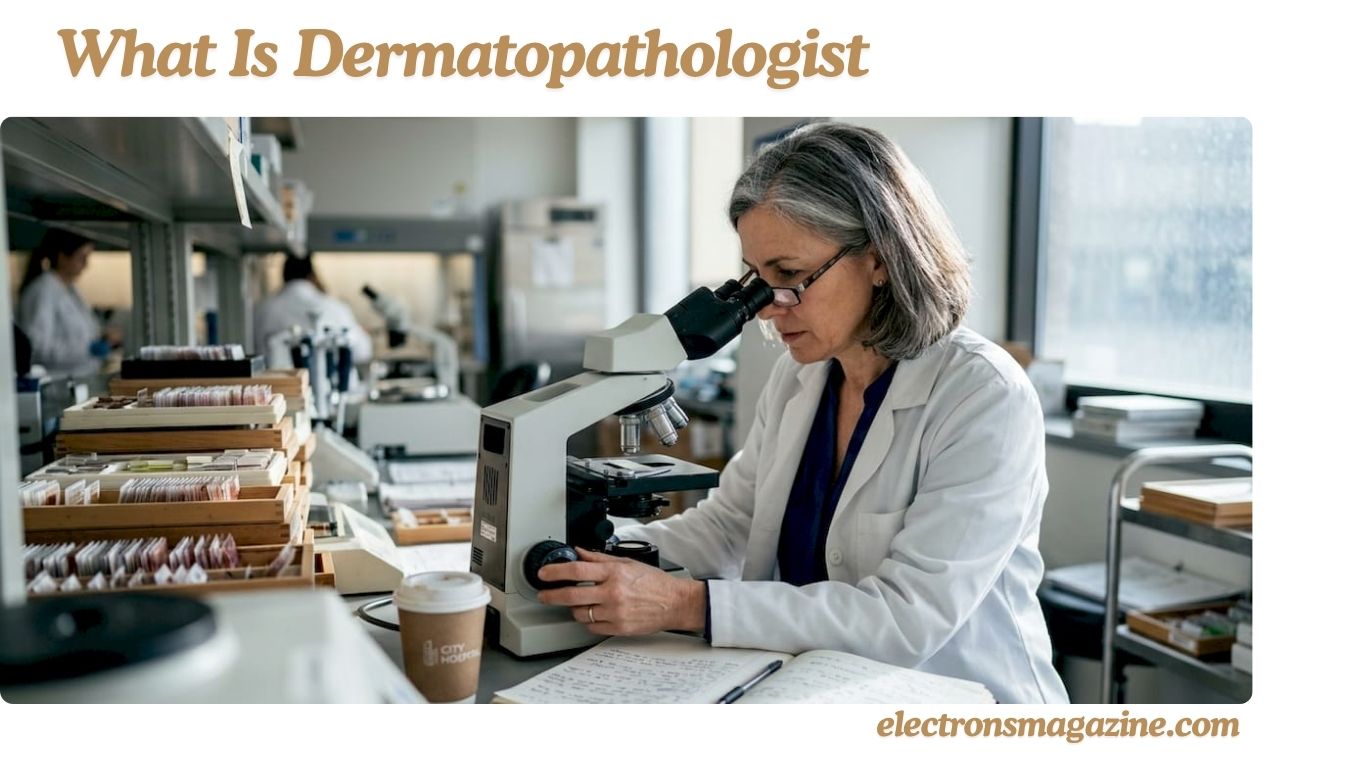
For example, imagine that a dermatologist sees a mole that looks unusual. The dermatologist may remove part or all of the lesion and send it to a laboratory. The tissue is processed into very thin sections, placed on glass slides, stained, and examined under a microscope.
The dermatopathologist studies the microscopic appearance of the tissue and uses medical knowledge to determine what the findings mean.
The diagnosis may be relatively simple, such as a benign mole. In other cases, the diagnosis may be more complex, such as melanoma, an inflammatory skin disorder, an autoimmune condition, or an uncommon skin tumor.
The important point is that a dermatopathologist does not simply “look at a picture of skin.” They examine actual tissue and evaluate patterns in cells and structures that may provide information that cannot be obtained from a visual skin examination alone.

Source: newsroom
What Does a Dermatopathologist Do?
The main job of a dermatopathologist is to examine and interpret specimens from the skin, hair, nails, and related tissues.
Most of their work is connected to biopsies. A physician may take a biopsy when a lesion, rash, mole, or other skin change needs a more precise diagnosis.
The dermatopathologist then studies the specimen and prepares a pathology report.
Depending on the case, the report may identify whether the tissue is normal, benign, precancerous, malignant, infectious, inflammatory, or associated with another disease process.
The work can involve several steps.
First, the specimen must be properly collected and submitted. The way a biopsy is taken can matter because some skin diseases affect particular layers or areas of tissue.
Next, laboratory professionals process the specimen. The tissue may be preserved, embedded, cut into very thin sections, and stained so that different structures can be seen under a microscope.
The dermatopathologist then examines the slides.
In difficult cases, additional stains or specialized laboratory techniques may be used. The goal is not simply to identify abnormal cells but to interpret the overall pattern and connect it with the patient’s clinical information.
Finally, the dermatopathologist communicates the findings in a pathology report.
That report is usually sent back to the physician who ordered the biopsy. The treating physician can then combine the pathology findings with the patient’s symptoms, medical history, physical examination, and other test results.
This teamwork is important because pathology is one part of the diagnostic process rather than the entire clinical picture.
Why Is a Dermatopathologist Important for Skin Diagnosis?
Skin conditions can sometimes look very similar even when they have completely different causes.
A red patch, for example, could be related to irritation, infection, inflammation, an immune disorder, or another condition. Likewise, a dark spot could be a harmless mole, a precancerous change, or melanoma.
A visual examination can provide important clues, but a biopsy may provide additional evidence.
This is one of the reasons dermatopathology is so valuable. The dermatopathologist evaluates the microscopic structure of the tissue and looks for patterns associated with particular diseases.
For suspected skin cancer, pathology can be particularly important. The National Cancer Institute notes that a biopsy is commonly used to establish a cancer diagnosis, with a pathologist examining the removed tissue and reporting the findings.
For some skin cancers, the pathology report may provide information that helps doctors determine how serious the disease is and plan treatment.
In other words, the dermatopathologist can serve as an important link between a skin biopsy and the final medical diagnosis.
What Conditions Does a Dermatopathologist Diagnose?
A dermatopathologist can diagnose a very wide range of skin diseases.
Their work is not limited to skin cancer. In fact, many biopsies are performed because doctors need help identifying noncancerous or inflammatory conditions.
Common categories include inflammatory skin diseases, infections, benign growths, precancerous lesions, and malignant tumors.
Examples of conditions that may be evaluated include eczema-related disorders, psoriasis, autoimmune skin diseases, drug reactions, unusual rashes, infections, benign moles, seborrheic keratoses, basal cell carcinoma, squamous cell carcinoma, and melanoma.
They may also evaluate less common tumors and unusual conditions affecting the hair follicles, sweat glands, or other structures of the skin.
One reason dermatopathology requires specialized expertise is that some diseases have overlapping microscopic features. The specialist must recognize subtle differences between conditions that may look similar.
Skin pathology can also involve more than one possible diagnosis. A dermatopathologist may sometimes describe a range of possibilities or recommend additional testing when the microscopic findings are not completely specific.
This is not necessarily a sign that something has gone wrong. Medicine often involves interpreting evidence when several conditions share similar characteristics.
How Does a Skin Biopsy Reach a Dermatopathologist?
A skin biopsy begins with the treating healthcare professional.
Usually, a dermatologist or another qualified clinician identifies an area that needs further evaluation. The clinician selects an appropriate biopsy technique based on the appearance and location of the lesion and the suspected diagnosis.
Several types of skin biopsy can be used.
A shave biopsy removes a superficial portion of the lesion. A punch biopsy uses a small circular instrument to remove a deeper cylindrical sample of skin. An excisional biopsy removes an entire lesion or a larger portion of it.
The National Cancer Institute describes shave, punch, and other biopsy approaches as methods used to obtain tissue for microscopic examination.
After the sample is removed, it is normally placed in a specimen container with an appropriate preservative and sent to a pathology laboratory.
The laboratory processes the tissue so that it can be examined under a microscope.
The dermatopathologist does not usually perform the biopsy. Instead, they typically examine the tissue after it has been collected.
This distinction is useful because patients sometimes assume that the doctor who removes a skin lesion is automatically the doctor who diagnoses the tissue. These can be two different physicians working together.
What Happens When a Dermatopathologist Examines a Biopsy?
The examination of a skin biopsy is a careful process.
The first step involves understanding the specimen and the clinical information supplied with it. Information about the patient’s symptoms, location of the lesion, clinical appearance, and suspected diagnosis can be extremely useful.
The tissue is then processed by the pathology laboratory.
A small specimen may be embedded in paraffin or another material and cut into extremely thin sections. These sections are placed on microscope slides and treated with stains that make different tissue structures easier to identify.
The dermatopathologist examines the slides under a microscope.
They may look at the arrangement of cells, the thickness and structure of the epidermis, changes in the dermis, inflammation, pigment, cellular abnormalities, growth patterns, and other microscopic features.
If the initial examination does not provide enough information, additional tests may be considered.
These can include special stains, immunohistochemistry, molecular tests, or other specialized techniques depending on the suspected condition.
The final interpretation is then documented in a pathology report.
The National Cancer Institute explains that pathology reports generally contain information about the specimen, microscopic findings, and a final diagnosis, along with comments when appropriate.
What Is Included in a Dermatopathology Report?
A dermatopathology report can look complicated because it is written for healthcare professionals.
However, most reports follow a logical structure.
The report may identify the location of the biopsy and describe how the specimen was obtained. It may also include a microscopic description and a final diagnosis.
The most important section for many patients is the final diagnosis.
For example, a report might identify a benign skin lesion, an inflammatory condition, or a type of skin cancer.
When cancer is diagnosed, additional information may be included depending on the type of cancer and the specimen.
Some reports describe margins, invasion, cellular characteristics, or other features that can influence treatment decisions.
It is important not to interpret a pathology report in isolation. Medical terms can have meanings that are different from their everyday use.
For this reason, patients should discuss the report with the doctor who ordered the biopsy.
The treating doctor can explain how the pathology findings relate to the appearance of the lesion, the patient’s medical history, and the next step in care.
What Is the Difference Between a Dermatologist and a Dermatopathologist?
A dermatologist and a dermatopathologist are closely connected, but their daily responsibilities are different.
A dermatologist is a physician who specializes in diagnosing and treating diseases of the skin, hair, and nails. Dermatologists may examine patients, prescribe medication, perform procedures, remove lesions, treat skin cancers, and manage long-term skin conditions. The American Academy of Dermatology notes that dermatologists are trained to diagnose and treat thousands of diseases involving the skin, hair, and nails.
A dermatopathologist focuses heavily on the microscopic diagnosis of skin disease.
A simple way to understand the difference is this:
The dermatologist examines the patient and the skin.
The dermatopathologist examines the tissue.
However, this is an oversimplification because many dermatopathologists have substantial clinical knowledge, and some may also practice dermatology.
The two specialists often work as a team.
A dermatologist may recognize that a lesion needs a biopsy. The dermatopathologist then examines the tissue and provides a diagnosis. The dermatologist uses that diagnosis to determine the next step.
This partnership is especially valuable when a skin condition is difficult to identify.
What Is the Difference Between a Dermatopathologist and a Pathologist?
A general pathologist is a medical doctor trained to diagnose disease by examining tissues, cells, blood, and other specimens.
Pathology includes many areas, such as surgical pathology, hematopathology, cytopathology, and other subspecialties.
Dermatopathology is a specialized area focused on diseases involving the skin and related structures.
A dermatopathologist therefore has focused expertise in the microscopic diagnosis of skin disease.
This specialization can be useful because skin has many unique structures and diseases. Understanding the clinical appearance of a skin lesion and matching it with microscopic findings requires specialized knowledge.
The American Board of Dermatology recognizes dermatopathology as a subspecialty, and dermatopathology certification involves the American Board of Dermatology and American Board of Pathology.
How Does Someone Become a Dermatopathologist in the United States?
Becoming a dermatopathologist requires extensive medical education and specialized training.
A physician first completes medical school and then completes residency training in an appropriate primary specialty.
In the United States, dermatopathology training is available to physicians who have completed qualifying training in dermatology or pathology.
After the required residency training, the physician can complete specialized dermatopathology fellowship training.
The Accreditation Council for Graduate Medical Education recognizes dermatopathology as a subspecialty and describes a one-year accredited fellowship focused on advanced dermatopathology training.
During fellowship training, physicians study a large number of dermatopathology specimens and develop advanced skills in recognizing skin diseases under the microscope.
Training includes more than simply memorizing what diseases look like.
Physicians learn how to connect clinical information with microscopic findings, communicate effectively with other healthcare professionals, and continually improve diagnostic skills.
The American Board of Dermatology states that dermatopathology subspecialty certification is jointly associated with the American Board of Dermatology and American Board of Pathology.
Patients who want to verify a physician’s credentials can use appropriate board certification resources and ask the healthcare facility about the specialist’s training and certification.
What Types of Skin Cancer Can a Dermatopathologist Identify?
Skin cancer is one of the most important areas of dermatopathology.
The major types of skin cancer include basal cell carcinoma, squamous cell carcinoma, and melanoma.
The National Cancer Institute identifies skin cancer as cancer that develops in the tissues of the skin and explains that melanoma begins in melanocytes, while basal cell and squamous cell carcinomas arise from different cells in the epidermis.
A dermatologist may recognize that a lesion looks suspicious, but the biopsy provides tissue that can be studied directly.
A dermatopathologist evaluates the specimen and determines whether cancer is present and, when appropriate, identifies the specific type.
For melanoma, pathology can provide important information about characteristics such as tumor thickness and ulceration.
This information can affect staging and treatment decisions.
Because some pigmented lesions can be difficult to classify, expert review can be valuable. The National Cancer Institute notes that distinguishing some benign pigmented lesions from early melanoma can be difficult, and a second pathology review may sometimes be considered.
This highlights an important point: pathology is highly specialized medical interpretation, and difficult cases may sometimes benefit from additional expert review.
Can a Dermatopathologist Diagnose Noncancerous Skin Problems?
Yes.
Dermatopathology is not only about cancer.
Many skin biopsies are performed to diagnose conditions that are not malignant.
Inflammatory skin diseases are an important part of dermatopathology. A biopsy may help evaluate conditions involving inflammation, immune reactions, unusual rashes, or changes in the structure of the skin.
Dermatopathologists may also diagnose infectious diseases, autoimmune disorders, medication-related reactions, and benign growths.
This is important because patients sometimes hear the word “pathology” and immediately worry about cancer.
A biopsy does not automatically mean cancer is suspected strongly enough to expect a cancer diagnosis. Doctors often perform biopsies because they need a more reliable answer.
In many cases, the final result is benign.
A biopsy can therefore provide reassurance as well as identify disease.
When Might a Doctor Send a Biopsy to a Dermatopathologist?
A biopsy may be considered when a skin problem cannot be diagnosed confidently from a physical examination alone.
Common situations include a changing mole, suspicious growth, persistent unexplained rash, unusual lesion, possible skin cancer, or a skin condition that has not responded to treatment as expected.
A biopsy may also be useful when several conditions appear similar.
For example, if a lesion has an unusual appearance, the dermatologist may want microscopic confirmation before deciding on treatment.
Another reason is that some diseases require information about the deeper structure of the skin.
The choice to biopsy is based on the individual situation. Not every skin lesion needs a biopsy, and the decision should be made by a qualified healthcare professional.
Patients should not attempt to diagnose suspicious skin lesions themselves using photographs or internet searches.
A picture can be useful for education, but it cannot replace an appropriate medical examination and, when needed, tissue diagnosis.
How Accurate Is Dermatopathology?
Dermatopathology is a highly specialized diagnostic field, but no medical test is perfect.
The accuracy of a diagnosis depends on several factors.
These include the quality and size of the biopsy, how the specimen was collected and processed, the clinical information provided, the microscopic features of the disease, and the experience of the interpreting physician.
Some diseases have classic microscopic patterns and can be diagnosed with relatively high confidence.
Other conditions are more difficult because several diseases can look similar under the microscope.
Pigmented lesions are a good example. Even experienced specialists can sometimes disagree about difficult cases. The National Cancer Institute specifically notes that histologic interpretation of some melanocytic lesions can vary among experienced dermatopathologists.
This does not mean that dermatopathology is unreliable. Instead, it demonstrates why difficult medical diagnoses sometimes require correlation with the clinical picture or review by another qualified specialist.
If a diagnosis seems unexpected or does not match the appearance of the lesion, a patient can discuss the situation with their dermatologist and ask whether additional review is appropriate.
Why Clinical Information Matters to a Dermatopathologist
One of the most important but often overlooked parts of dermatopathology is clinical information.
A microscope does not tell the whole story.
Suppose a dermatopathologist sees inflammation in a skin biopsy. Several different diseases can cause inflammation. Knowing where the lesion appeared, how long it has been present, what it looks like, whether it itches or hurts, and what treatments have already been tried can help narrow the possibilities.
This is why the dermatologist’s information on the biopsy request form can be valuable.
The best diagnosis often comes from combining two perspectives.
The first is the clinical perspective: what the patient looks like, what symptoms they have, and how the lesion developed.
The second is the microscopic perspective: what the tissue looks like at the cellular level.
Dermatopathology is strongest when these two sources of information agree.
This is also why patients should tell their dermatologist about changes in a lesion, medications, previous skin conditions, and other relevant information.
Good communication can improve the diagnostic process.
What Happens After the Dermatopathology Diagnosis?
Once the dermatopathologist completes the report, the result is generally sent to the physician who ordered the biopsy.
The next step depends on the diagnosis.
If the lesion is benign and completely removed, no further treatment may be needed.
If the biopsy identifies a condition such as an inflammatory skin disease, the dermatologist may recommend medication or another treatment.
If skin cancer is diagnosed, the next steps may include additional surgery, specialist referral, surveillance, or another cancer treatment depending on the type and characteristics of the cancer.
A pathology report does not always mean that treatment begins immediately.
Sometimes the report provides information that needs to be combined with other findings before a final plan is made.
For example, the treating physician may need to consider whether the lesion was completely removed, the type of cancer, the location, and other patient-specific factors.
The pathology report is therefore an important part of the larger treatment decision rather than a standalone treatment plan.
Should You Get a Second Opinion From a Dermatopathologist?
A second opinion is not necessary for every biopsy.
Many common diagnoses can be made confidently by a qualified dermatopathologist.
However, a second review may be reasonable in selected situations.
This can include an unusual diagnosis, a rare tumor, a difficult pigmented lesion, a diagnosis that does not match the clinical appearance, or a situation where the treatment decision is especially significant.
The National Cancer Institute notes that difficult distinctions between benign pigmented lesions and melanoma may sometimes justify review by another qualified pathologist.
If you are considering a second opinion, talk with your dermatologist or treating physician first.
They can help determine whether another pathology review would add useful information.
A second opinion should not automatically be viewed as questioning the competence of the first doctor. Complex medical cases sometimes benefit from more than one expert perspective.
How Patients Can Better Understand a Dermatopathology Report
A pathology report can contain unfamiliar medical terminology, so it is normal for patients to have questions.
Start by looking for the final diagnosis.
Do not assume that every medical term in the report represents cancer. Words such as lesion, neoplasm, atypical, dysplastic, inflammatory, or proliferation can have specific medical meanings that require context.
Ask the physician who ordered the biopsy to explain the result in plain language.
Useful questions may include:
What exactly did the biopsy show?
Is the condition benign, precancerous, or cancerous?
Was the lesion completely removed?
Do I need another procedure?
Do I need treatment?
Do I need follow-up examinations?
Would a second pathology opinion be useful?
If cancer was diagnosed, ask whether the report contains information that affects staging or treatment.
The National Cancer Institute explains that pathology reports can provide information used for diagnosis, staging, and treatment planning.
Understanding the report is much easier when the medical terminology is explained in the context of your individual case.
Conclusion
So, what is dermatopathologist?
A dermatopathologist is a specially trained physician who combines knowledge of dermatology and pathology to diagnose diseases by examining skin, hair, nail, and related tissue samples.
Their work usually begins after a healthcare professional performs a biopsy. The specimen is processed in a laboratory and examined under a microscope. The dermatopathologist interprets the tissue and creates a pathology report that helps the treating physician understand the condition.
Dermatopathologists play an important role in diagnosing both cancerous and noncancerous skin diseases. Their expertise can be especially valuable when a lesion is unusual, when several conditions look alike, or when a biopsy needs detailed interpretation.
They are also an important part of the skin cancer diagnosis process. A pathology diagnosis can provide information that helps doctors determine the appropriate next step in treatment.
For patients, the most important takeaway is that a biopsy is a diagnostic tool, not automatically a sign that cancer has been found. If you receive a pathology report, discuss it with your doctor rather than trying to interpret unfamiliar terminology on your own.
Modern dermatology depends on teamwork. The dermatologist evaluates the patient, the dermatopathologist studies the tissue, and other healthcare professionals may contribute when needed. Together, these perspectives can produce a more complete understanding of a skin problem.
If you have a changing mole, unusual growth, persistent rash, or other concerning skin change, a qualified healthcare professional can determine whether further evaluation or a biopsy is appropriate.
Frequently Asked Questions
Is a dermatopathologist a real medical doctor?
Yes. A dermatopathologist is a physician who has completed medical training and additional specialized training in dermatopathology. In the United States, dermatopathology is a recognized medical subspecialty with accredited fellowship training and subspecialty certification pathways.
Does every skin biopsy need to be examined by a dermatopathologist?
Not necessarily. Biopsy specimens may be evaluated by qualified pathologists, and many healthcare systems have specialists with expertise in dermatopathology. For complex skin lesions, a dermatologist may specifically choose a dermatopathologist because of their focused experience with skin disease.
Can a dermatopathologist examine hair and nail problems?
Yes. Dermatopathology includes diseases affecting skin and related structures, including conditions involving hair follicles and nails. The exact specimen and testing depend on the suspected diagnosis.
Can a dermatopathologist tell how long a skin lesion has been present?
Usually, pathology cannot provide an exact date for when a lesion began. Microscopic findings may provide information about the nature and development of a disease, but they generally cannot tell a patient precisely how many days, weeks, or years a lesion has existed.
Can a dermatopathologist diagnose a skin condition without a biopsy?
Dermatopathologists primarily provide diagnoses from tissue and cellular specimens. A dermatologist or other clinician may diagnose many skin conditions clinically without a biopsy. Dermatopathology becomes particularly useful when microscopic examination is needed to confirm or clarify a diagnosis.