

If you have never visited a dermatologist before, you may wonder, “what do they do at a dermatology appointment?” Knowing what happens during the visit can make the experience much less stressful.
A dermatology appointment is not only about looking at a rash or treating acne. A dermatologist is a medical doctor who diagnoses and treats conditions involving the skin, hair, and nails. Depending on the reason for your visit, your dermatologist may examine one specific area, perform a full skin examination, check your scalp or nails, review your medical history, recommend tests, perform a procedure, prescribe medication, or create a long-term skin care plan.
The exact appointment is different for every patient. Someone visiting for acne may have a very different experience from someone concerned about a changing mole, hair loss, eczema, psoriasis, or a suspicious skin growth.
In the United States, dermatology visits may also include preventive skin checks. During these visits, a dermatologist may look for signs of skin cancer and other changes that deserve attention. The American Academy of Dermatology notes that a full-body skin examination can be performed in a private setting when appropriate.
This guide explains what happens at a dermatology appointment, what your dermatologist may ask, what examinations and tests may be performed, how treatment decisions are made, and how you can prepare for your visit.
What Do They Do at a Dermatology Appointment?
So, what do they do at a dermatology appointment?
In a typical visit, the dermatologist may:
- Review your reason for the visit.
- Ask about your symptoms and medical history.
- Review medications and supplements.
- Examine your skin, hair, or nails.
- Check other areas if necessary.
- Use a special magnifying device to examine a spot.
- Perform a skin biopsy or other test when needed.
- Diagnose the condition or discuss possible diagnoses.
- Recommend treatment.
- Explain how to use medications or skin-care products.
- Discuss prevention and lifestyle measures.
- Arrange follow-up care if necessary.
Not every patient needs every step.
For example, a person with straightforward acne may only need a medical history, skin examination, diagnosis, and treatment plan. A person with a suspicious mole may need a closer examination and possibly a biopsy.
Source: Goodman Dermatology
What Happens When You First Arrive?
Before seeing the dermatologist, you may check in at the front desk and complete paperwork.
The office may ask for information such as:
- Your personal and contact information
- Insurance information
- Your reason for the visit
- Current medications
- Allergies
- Medical history
- Previous surgeries
- Previous dermatology treatments
If you are a new patient, the paperwork may take several minutes.
It is useful to bring an accurate list of medications, vitamins, and supplements. Some products can affect the skin or interact with treatments. The American Academy of Dermatology recommends preparing this information before a dermatology visit.
You may also be asked about previous skin conditions and whether other family members have certain medical conditions.
What Questions Will a Dermatologist Ask?
Your dermatologist will usually ask questions related to your main concern.
For example, if you have a rash, they may ask:
- When did the rash begin?
- Has it changed?
- Does it itch?
- Does it hurt?
- Is it spreading?
- Have you used anything on it?
- Have you recently changed soaps or skin products?
- Have you started a new medication?
- Have you been exposed to anything unusual?
- Does anyone else in your household have similar symptoms?
If you are visiting for acne, the dermatologist may ask how long you have had acne and what treatments you have already tried. The American Academy of Dermatology recommends being prepared to explain previous treatments and how your condition has changed.
For hair loss, questions may include when the hair loss started, whether it is sudden or gradual, whether other family members have hair loss, and whether you have experienced recent illnesses, stress, or changes in medication.
For a changing mole, the dermatologist may ask when you first noticed the change and whether the mole has changed in size, shape, color, or symptoms.
These questions are not simply paperwork. They help the dermatologist connect what you are experiencing with what can be seen during the examination.
Does a Dermatologist Examine Your Whole Body?
It depends on why you are visiting.
If you schedule an appointment for a specific issue, your dermatologist may focus primarily on that area. However, the doctor may also examine other areas if they could provide important information.
For example, psoriasis can affect the skin, scalp, and nails. A dermatologist may therefore examine all three. The American Academy of Dermatology explains that dermatologists may examine the skin, nails, and scalp when evaluating psoriasis.
A full-body skin examination may also be performed when you are concerned about skin cancer or when a comprehensive skin check is appropriate.
During a full-body examination, the dermatologist may inspect areas such as:
- Face
- Scalp
- Neck
- Chest
- Back
- Arms
- Hands
- Legs
- Feet
- Between fingers and toes
- Nails
- Other areas of the skin
The doctor may ask you to change into a gown so that different areas can be examined privately.
You can always ask what the doctor plans to examine before the examination begins.
What Happens During a Skin Examination?
The dermatologist visually examines your skin for changes.
They may look for:
- Changes in color
- Redness
- Scaling
- Swelling
- Bumps
- Blisters
- Growths
- Moles
- Crusting
- Sores
- Scarring
- Signs of infection
- Unusual patterns
The dermatologist may also compare different areas of your skin.
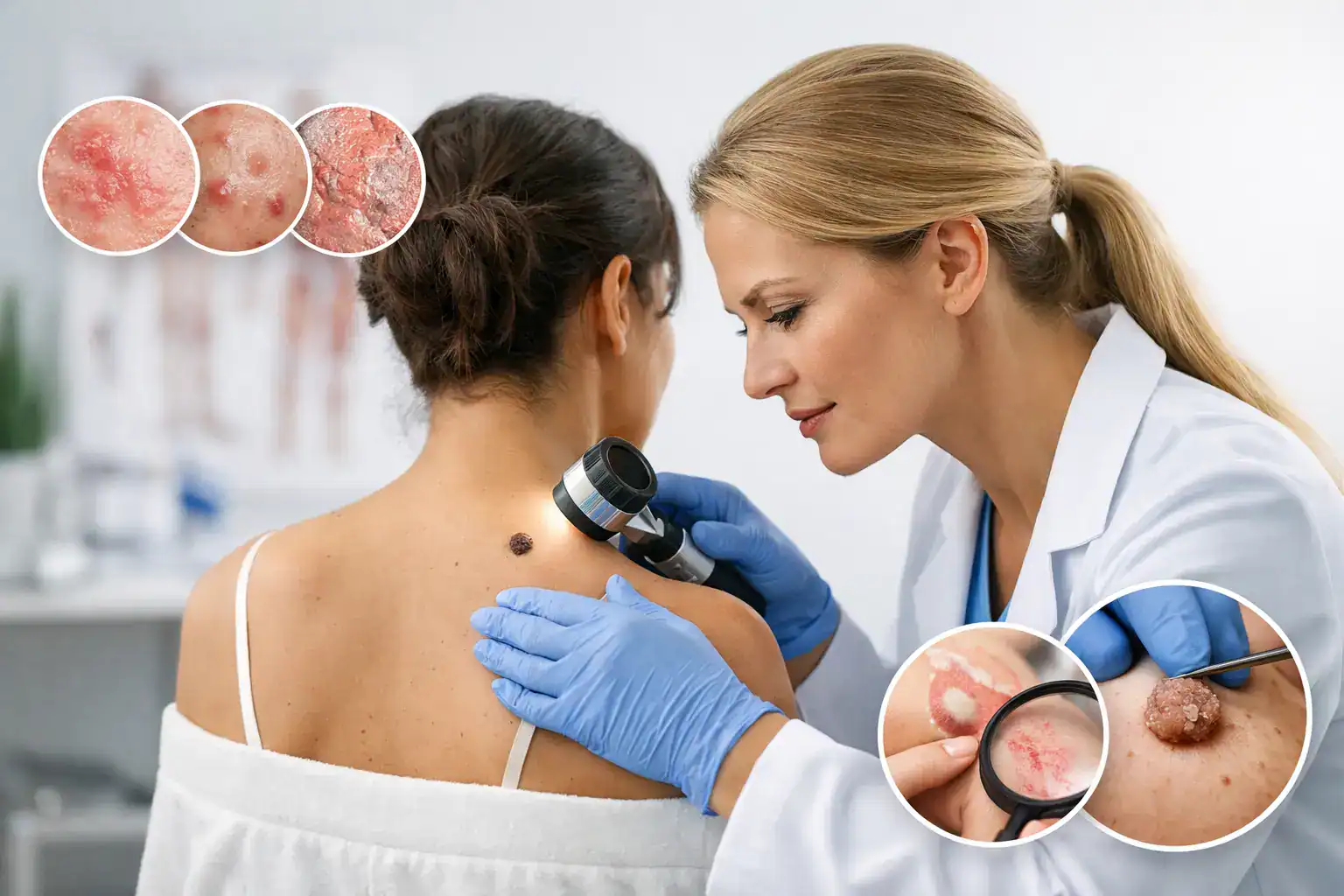
For a suspicious mole or growth, the doctor may use a handheld magnifying instrument called a dermatoscope. This allows the dermatologist to see details that may not be obvious to the naked eye.
A skin examination is usually not painful.
If the doctor finds something concerning, they may recommend monitoring it, taking a photograph, performing a biopsy, or removing it depending on the situation.
What Happens During a Skin Biopsy?
A skin biopsy involves removing a small sample of skin so it can be examined in a laboratory.
A biopsy may be recommended for several reasons, including suspicious moles, skin cancer concerns, unusual growths, or certain inflammatory skin conditions. Mayo Clinic describes shave, punch, incisional, and excisional biopsies as common types of skin biopsy.
Before the biopsy, the dermatologist usually cleans the area and injects a local anesthetic to numb it.
The numbing injection may briefly sting or burn.
Once the area is numb, the procedure itself should not cause significant pain.
The type of biopsy depends on the lesion and the information the doctor needs.
Shave Biopsy
A shave biopsy removes a shallow portion of the abnormal skin.
It is often used for certain surface lesions.
Stitches are usually not required for a typical shave biopsy.
Punch Biopsy
A punch biopsy uses a small circular instrument to remove a deeper section of skin.
Because it removes deeper tissue, stitches may sometimes be needed.
Excisional Biopsy
An excisional biopsy removes the entire suspicious area or growth, along with some surrounding tissue when appropriate.
Stitches are often used to close the area.
What Happens to the Biopsy Sample?
The tissue is sent to a laboratory where it is examined under a microscope.
The results may help determine whether the lesion is benign, precancerous, cancerous, infectious, inflammatory, or something else.
Results can take several days, although more complicated testing can take longer.
A biopsy does not automatically mean that cancer is suspected. Doctors use biopsies for many different skin conditions because laboratory examination can provide information that cannot always be obtained from looking at the skin.procedure.
Will a Dermatologist Check Your Hair and Scalp?
If your symptoms involve the hair or scalp, the dermatologist may carefully examine both.
Dermatologists treat many hair and scalp problems, including:
- Hair thinning
- Hair loss
- Scalp itching
- Dandruff
- Scalp inflammation
- Certain infections
- Hair breakage
- Some forms of scarring hair loss
The dermatologist may look at the scalp closely and examine individual hairs.
Depending on the suspected cause, additional testing may sometimes be needed.
The important point is that hair loss has many possible causes. Treatment works best when the underlying cause is identified rather than simply treating the visible hair loss.
Will a Dermatologist Check Your Nails?
Yes, especially if you have a nail concern or a condition that can affect the nails.
The dermatologist may examine:
- Nail color
- Nail thickness
- Nail shape
- Nail texture
- Separation of the nail
- Lines or ridges
- Pitting
- Swelling around the nail
Nail changes can result from infections, psoriasis, injuries, medications, or other medical conditions.
If an infection is suspected, the dermatologist may take a nail clipping or scrape material from beneath the nail for laboratory testing. The American Academy of Dermatology describes this approach for suspected nail infections in people with nail psoriasis.
What Happens If You Have Acne?
An acne appointment usually begins with a discussion of your acne history.
Your dermatologist may ask:
- When did your acne begin?
- Where does it appear?
- Does it leave dark spots?
- Have you developed scars?
- What products have you used?
- Have you tried prescription treatments?
- Are you taking any medications?
- Does acne appear to follow a particular pattern?
The dermatologist then examines the skin.
Treatment depends on the type and severity of acne.
Possible treatment options include topical medications, oral medicines, hormonal treatment for appropriate patients, procedures, or combinations of treatments.
The American Academy of Dermatology notes that acne treatment can include topical medications such as retinoids and other FDA-approved treatments.
The goal is not simply to treat today’s pimples. A good treatment plan also considers preventing new breakouts and reducing the risk of scarring.
What Happens If You Have Eczema?
If you visit because of eczema, the dermatologist will usually examine the affected skin and ask about your symptoms.
They may ask about:
- Itching
- Dryness
- Flare-ups
- Triggers
- Skin-care products
- Previous treatments
- Allergies
- Other medical conditions
The dermatologist may recommend moisturizers, prescription medications, trigger avoidance, or other treatments depending on the type and severity of eczema.
A useful dermatology visit should leave you understanding not only what medicine to use but also how to use it and what to expect during treatment.
What Happens If You Have Psoriasis?
Psoriasis can affect more than the skin.
A dermatologist may examine the skin, scalp, and nails and ask about symptoms such as itching.
They may also ask about joint symptoms because psoriasis can be associated with psoriatic arthritis. The American Academy of Dermatology specifically recommends asking patients with suspected psoriasis about joint problems, nail changes, family history, and recent changes such as illness or stress.
Treatment depends on the severity and location of psoriasis.
Options may include topical treatments, phototherapy, oral medicines, injectable medicines, or biologic medications.
Not everyone with psoriasis needs the same treatment. The dermatologist considers the extent of disease, symptoms, location, medical history, and previous treatment response.
What Happens If You Have a Suspicious Mole?
If you are concerned about a mole, the dermatologist will examine it carefully.
They may ask whether it has:
- Changed size
- Changed shape
- Changed color
- Started itching
- Started bleeding
- Developed a new appearance
The dermatologist may compare it with other moles on your body.
If the mole appears concerning, the doctor may recommend a biopsy.
Mayo Clinic notes that a suspicious mole may be removed and sent to a laboratory for microscopic examination.
The important thing to remember is that a suspicious appearance does not automatically mean cancer. Testing is sometimes necessary to determine what the lesion actually is.
Can a Dermatologist Diagnose Skin Cancer?
Dermatologists are trained to recognize suspicious skin changes and diagnose skin cancers.
A skin cancer evaluation generally starts with a medical history and examination of the skin. If a lesion is concerning, a biopsy may be performed so the tissue can be examined in a laboratory.
Different types of skin cancer can look different, and some may resemble noncancerous conditions.
That is why a professional examination is important when a skin lesion changes or does not heal.
Will the Dermatologist Prescribe Medicine?
They may.
The medication depends entirely on the diagnosis.
A dermatologist may prescribe:
- Creams
- Ointments
- Gels
- Lotions
- Oral medications
- Injections
- Medicated shampoos
- Nail treatments
- Other specialized therapies
The dermatologist should explain how often to use the treatment, where to apply it, how long to use it, and what side effects to watch for.
Do not assume that using more medication will make a skin condition improve faster. Some dermatology medicines can irritate the skin when used incorrectly.
Following the prescribed instructions is an important part of successful treatment.
Can a Dermatologist Recommend Skin-Care Products?
Yes.
A dermatologist may recommend basic skin-care changes as part of medical treatment.
These may include:
- A gentle cleanser
- Moisturizer
- Sunscreen
- Fragrance-free products
- A particular shampoo
- Products designed for sensitive skin
- Specific acne products
The recommendation depends on your condition.
For example, someone with eczema may need a different skin-care routine from someone with oily, acne-prone skin.
One of the most useful questions you can ask is, “Which products should I stop using?”
Many people focus on adding products when removing irritating products may be more helpful.
Can Dermatologists Perform Procedures?
Yes.
Dermatologists perform many procedures, depending on their training and the services offered by the practice.
Examples may include:
- Skin biopsies
- Mole removal
- Cyst treatment
- Wart treatment
- Cryotherapy
- Certain scar treatments
- Some laser procedures
- Treatment of precancerous lesions
- Cosmetic procedures
Not every dermatology office offers every procedure.
Some treatments may also require a separate appointment.
Do Dermatologists Treat Cosmetic Concerns?
Yes.
Dermatologists can also help patients with cosmetic skin concerns.
Depending on the practice, services may include treatment for:
- Fine lines
- Wrinkles
- Acne scars
- Uneven pigmentation
- Certain scars
- Sun-related skin changes
- Unwanted hair
- Some vascular skin changes
However, cosmetic treatments are different from medically necessary care and may not be covered by health insurance.
If you are considering a cosmetic procedure, ask about the expected results, risks, number of treatments, recovery time, and total cost before starting.
How Long Does a Dermatology Appointment Take?
There is no single appointment length for every patient.
A simple follow-up visit may be relatively short.
A first appointment may take longer because the dermatologist needs to learn about your medical history, examine your concern, review previous treatments, and create a treatment plan.
A full-body skin examination or appointment involving a procedure may also require additional time.
The American Academy of Dermatology reports that its rapid skin cancer screening checks take approximately 10 minutes, but it also explains that these checks do not replace a regular examination with a physician or dermatologist.
A regular medical dermatology appointment can therefore be very different from a rapid screening event.
If you have a specific procedure planned, ask the office how much time you should allow.
What Questions Should You Ask Your Dermatologist?
You do not need to know medical terminology to have a productive appointment.
Useful questions include:
- What do you think is causing this problem?
- What is the diagnosis?
- Do I need any testing?
- What treatment do you recommend?
- How should I use this medication?
- How long should I use it?
- When should I expect improvement?
- What side effects should I watch for?
- What should I avoid?
- Could this condition come back?
- Do I need a follow-up appointment?
- What symptoms should make me contact the office sooner?
If you do not understand something, ask the dermatologist to explain it in simple language.
The American Academy of Dermatology specifically encourages patients to ask questions about unfamiliar medical terms and write down important information.
Can You Have a Dermatology Appointment Online?
Yes, some dermatology care can be provided through telemedicine.
A telemedicine visit may involve video, telephone communication, or securely sending photographs and information through a patient portal or another approved system.
Teledermatology can be useful for some skin concerns and follow-up visits.
However, an in-person examination may be necessary when the dermatologist needs to physically examine the skin, perform a procedure, collect a sample, or evaluate something that cannot be adequately assessed remotely.
If you are unsure whether your problem can be handled online, ask the dermatology office when scheduling.
Conclusion
If you were wondering, “what do they do at a dermatology appointment?”, the answer is that there is much more involved than simply looking at your skin.
A dermatologist may review your medical history, ask detailed questions, examine your skin, hair, or nails, perform a full-body skin check, use specialized tools, take photographs, order testing, perform a biopsy, prescribe medication, recommend skin-care changes, or perform a procedure.
The exact process depends on why you are visiting.
The best way to prepare is to know your symptoms, bring your medication list, bring relevant medical records, avoid heavy products that could hide your skin, and write down your questions.
Most importantly, do not be embarrassed about asking questions. Dermatology appointments are designed to help you understand what is happening and what you can do about it.
A successful visit should leave you with a clear understanding of your condition, a practical treatment plan, and a plan for what happens next.
FAQs
1. Can I ask a dermatologist about a skin problem that is not the reason for my appointment?
Yes, but it is best to tell the office about additional concerns when scheduling so enough appointment time can be reserved.
2. Can I bring someone with me to a dermatology appointment?
Many offices allow a support person, although policies vary. If you want someone to accompany you, check the practice’s policy before your visit.
3. Can a dermatologist tell if a skin problem is caused by stress?
A dermatologist may consider stress as one possible factor, but they will usually evaluate your symptoms, medical history, examination findings, and other possible causes before reaching a conclusion.
4. Can I request a female or male dermatologist?
Many practices can accommodate a preference when scheduling, although availability varies. It is reasonable to ask the office when making your appointment.
5. What happens if I disagree with the dermatologist’s recommended treatment?
You can ask about alternatives, expected benefits, risks, costs, and what may happen if you choose not to start treatment. Shared discussion can help you make a decision that fits your needs.